
The SEEP Network: Leading Collaboration and Learning
  • Casino utan svensk licens
  • Om oss
  • Kontakta oss


  • Contact Us
  • Receive SEEP Updates


  • SEEP Member Space
  • Become a Member

  • About
    • Our Story
    • Our Core Values
    • Our Team
    • Partner with SEEP
    • Board of Directors
    • COVID-19 Response
  • Membership
    • Meet Our Members
    • Benefits
    • How to Apply
    • SEEP & AMEA Partnership
    • SEEP Member Marketplace
    • SEEP Member Space
    • GenerationNOW
  • Thematic Areas
    • Agriculture & Food Security  
      • Agriculture & Food Security Resource Library
    • Resilient Markets  
      • Minimum Economic Recovery Standards
      • Markets in Crises Community of Practice
      • Livelihoods and Inclusive Finance Expansion
      • Disaster Risk Reduction
      • Resilient Markets Resource Library
    • Responsible Finance  
      • Responsible Finance through Local Leadership and Learning
      • Association Services
      • Online Courses and Certification in Digital Finance
      • Responsible Finance Resource Library
    • Savings Groups  
      • Women Saving for Resilience
      • Mastercard Foundation Savings Learning Lab
      • Savings-Led Working Group
      • Savings Groups Evidence and Learning Initiative
      • Red GALAC
      • The Mango Tree
      • SG2020: The Future of Savings Groups
    • Women’s Economic Empowerment  
      • WEE Global Learning Forum
      • WEE Working Group
      • WEE Peer Learning Group
      • AWEF Learning Series
      • WEE Resource Library
  • SEEP Resources
  • Blogs and Webinars
    • Blogs
    • Webinars on Demand
  • Events
  • Conferences
    • 2020 SEEP Annual Conference
    • SG2020: The Future of Savings Groups
    • 2017 Women’s Economic Empowerment Global Learning Forum
  • Contact Us
  • Receive SEEP Updates
  • SEEP Member Space
  • Become a Member


 Back

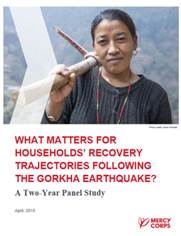
What matters for households’ recovery trajectories following the Gorkha earthquake? A two-year panel study

  2018 | Mercy Corps

Download

In April 2015, a 7.8 magnitude earthquake struck Nepal, killing over 9,000 people, destroying or badly damaging more than 800,000 homes and displacing approximately 2.8 million people. Where shocks like earthquakes cannot easily be prevented, strengthening the ability to prepare, respond and recover is critical to maintaining development gains in spite of them. In this context, resilience can be thought of as the combination of pre-existing capacities and the responses used to cope and recover in the aftermath. Ultimately, the ability of households to maintain their long-term wellbeing in the face of shocks depends upon the combination of their capacities and how they are used. To understand what mattered for recovery in the short and long-term, this study followed the same households 10 weeks, one year and two years after the Gorkha earthquake. The analysis will explore what factors mattered most for short-term coping and longterm recovery in order to improve humanitarian response and design of recovery programs in the aftermath of acute disasters.

Tags: asset, credit, crisis, disaster, disaster risk reduction, economic recovery, emergency, financial services, informal economy, informal sector, livelihoods, outcome, shelter

Search by Keyword


Filter by Categories


Topics

  • All
  • Consumer Protection
  • Economic Strengthening and Recovery
  • Financial Inclusion
  • Food Security
  • Fragile and Conflict-affected Environments
  • Health
  • Livelihoods
  • Market Systems
  • Microenterprise
  • Microfinance
  • Monitoring and Evaluation
  • Rural and Agricultural Finance
  • Savings Groups
  • Technology
  • Women and Girls
  • Youth and Children


Thematic Areas

  • All
  • Agriculture & Food Security
  • Resilient Markets
  • Responsible Finance
  • Savings Groups
  • Women’s Economic Empowerment


Language

  • All
  • Arabic
  • English
  • French
  • Portuguese
  • Spanish


Geographical Region

  • All
  • Eastern Europe and Central Asia
  • Global
  • North America
  • South Asia
  • Sub-Saharan Africa
  • Western Europe


Year Published

  • 2021
  • 2020
  • 2019
  • 2018
  • 2017
  • 2016
  • 2015
  • 2014
  • 2013
  • 2012
  • 2011
  • 2010
  • 2009
  • 2008
  • 2007
  • 2006
  • 2005
  • 2004
  • 2003

  • Villkor
  • Ansvarsfullt spelande
  • Integritetspolicy
Copyright © 2026