The SEEP Network: Leading Collaboration and Learning
  • Casino utan svensk licens
  • Om oss
  • Kontakta oss


  • Contact Us
  • Receive SEEP Updates


  • SEEP Member Space
  • Become a Member

  • About
    • Our Story
    • Our Core Values
    • Our Team
    • Partner with SEEP
    • Board of Directors
    • COVID-19 Response
  • Membership
    • Meet Our Members
    • Benefits
    • How to Apply
    • SEEP & AMEA Partnership
    • SEEP Member Marketplace
    • SEEP Member Space
    • GenerationNOW
  • Thematic Areas
    • Agriculture & Food Security  
      • Agriculture & Food Security Resource Library
    • Resilient Markets  
      • Minimum Economic Recovery Standards
      • Markets in Crises Community of Practice
      • Livelihoods and Inclusive Finance Expansion
      • Disaster Risk Reduction
      • Resilient Markets Resource Library
    • Responsible Finance  
      • Responsible Finance through Local Leadership and Learning
      • Association Services
      • Online Courses and Certification in Digital Finance
      • Responsible Finance Resource Library
    • Savings Groups  
      • Women Saving for Resilience
      • Mastercard Foundation Savings Learning Lab
      • Savings-Led Working Group
      • Savings Groups Evidence and Learning Initiative
      • Red GALAC
      • The Mango Tree
      • SG2020: The Future of Savings Groups
    • Women’s Economic Empowerment  
      • WEE Global Learning Forum
      • WEE Working Group
      • WEE Peer Learning Group
      • AWEF Learning Series
      • WEE Resource Library
  • SEEP Resources
  • Blogs and Webinars
    • Blogs
    • Webinars on Demand
  • Events
  • Conferences
    • 2020 SEEP Annual Conference
    • SG2020: The Future of Savings Groups
    • 2017 Women’s Economic Empowerment Global Learning Forum
  • Contact Us
  • Receive SEEP Updates
  • SEEP Member Space
  • Become a Member


 Back

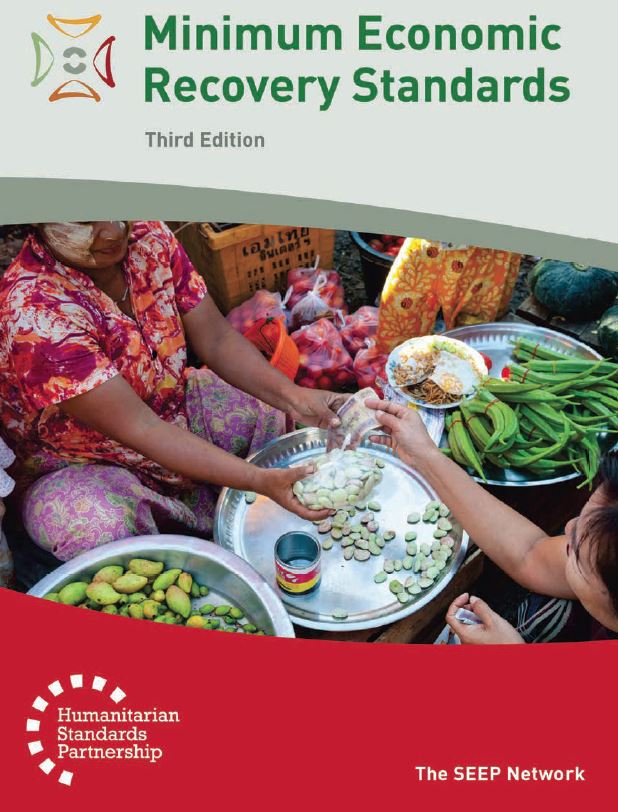
Minimum Economic Recovery Standards: Third Edition

  2017 | The SEEP Network

Download

The MERS offer tools for humanitarian agencies, inter-governmental organizations, local populations and government departments to enhance the effectiveness and quality of the economic assistance offered, and thus make a significant difference in the lives of the people affected by disasters.

The MERS provide guidance on what good programming looks like and what to consider when you are planning your activities. You can read each section separately or in sequence. Each section has cross-references to other chapters or sections that may also be relevant, because many of the Standards or actions are linked. This book will be most useful to field practitioners and humanitarians implementing programs immediately after a crisis. Donors, governments, private-sector actors, proposal writers, and operational staff may also find it a helpful reference point when designing or reviewing project activities. There will always be a tension between universal standards and the ability to apply them in the moment. Each context is different, and local conditions may make it impossible to meet these standards. This book offers the reader with an understanding of the results that implementers should be working towards.

Download the compressed file.

The MERS is a member of the Humanitarians Standards Partnership and the economic recovery standard for the Sphere Project.

Contact

For more information on this resource, contact [email protected]

Tags: economic recovery, financial inclusion, guidance, humanitarian, livelihoods, market analysis, market assessment, market chain, market system development, standards, toolkit and guidance

Search by Keyword


Filter by Categories


Topics

  • All
  • Consumer Protection
  • Economic Strengthening and Recovery
  • Financial Inclusion
  • Food Security
  • Fragile and Conflict-affected Environments
  • Health
  • Livelihoods
  • Market Systems
  • Microenterprise
  • Microfinance
  • Monitoring and Evaluation
  • Rural and Agricultural Finance
  • Savings Groups
  • Technology
  • Women and Girls
  • Youth and Children


Thematic Areas

  • All
  • Agriculture & Food Security
  • Resilient Markets
  • Responsible Finance
  • Savings Groups
  • Women’s Economic Empowerment


Language

  • All
  • Arabic
  • English
  • French
  • Portuguese
  • Spanish


Geographical Region

  • All
  • Eastern Europe and Central Asia
  • Global
  • North America
  • South Asia
  • Sub-Saharan Africa
  • Western Europe


Year Published

  • 2021
  • 2020
  • 2019
  • 2018
  • 2017
  • 2016
  • 2015
  • 2014
  • 2013
  • 2012
  • 2011
  • 2010
  • 2009
  • 2008
  • 2007
  • 2006
  • 2005
  • 2004
  • 2003

  • Villkor
  • Ansvarsfullt spelande
  • Integritetspolicy
Copyright © 2026