The SEEP Network: Leading Collaboration and Learning
  • Casino utan svensk licens
  • Om oss
  • Kontakta oss


  • Contact Us
  • Receive SEEP Updates


  • SEEP Member Space
  • Become a Member

  • About
    • Our Story
    • Our Core Values
    • Our Team
    • Partner with SEEP
    • Board of Directors
    • COVID-19 Response
  • Membership
    • Meet Our Members
    • Benefits
    • How to Apply
    • SEEP & AMEA Partnership
    • SEEP Member Marketplace
    • SEEP Member Space
    • GenerationNOW
  • Thematic Areas
    • Agriculture & Food Security  
      • Agriculture & Food Security Resource Library
    • Resilient Markets  
      • Minimum Economic Recovery Standards
      • Markets in Crises Community of Practice
      • Livelihoods and Inclusive Finance Expansion
      • Disaster Risk Reduction
      • Resilient Markets Resource Library
    • Responsible Finance  
      • Responsible Finance through Local Leadership and Learning
      • Association Services
      • Online Courses and Certification in Digital Finance
      • Responsible Finance Resource Library
    • Savings Groups  
      • Women Saving for Resilience
      • Mastercard Foundation Savings Learning Lab
      • Savings-Led Working Group
      • Savings Groups Evidence and Learning Initiative
      • Red GALAC
      • The Mango Tree
      • SG2020: The Future of Savings Groups
    • Women’s Economic Empowerment  
      • WEE Global Learning Forum
      • WEE Working Group
      • WEE Peer Learning Group
      • AWEF Learning Series
      • WEE Resource Library
  • SEEP Resources
  • Blogs and Webinars
    • Blogs
    • Webinars on Demand
  • Events
  • Conferences
    • 2020 SEEP Annual Conference
    • SG2020: The Future of Savings Groups
    • 2017 Women’s Economic Empowerment Global Learning Forum
  • Contact Us
  • Receive SEEP Updates
  • SEEP Member Space
  • Become a Member


 Back

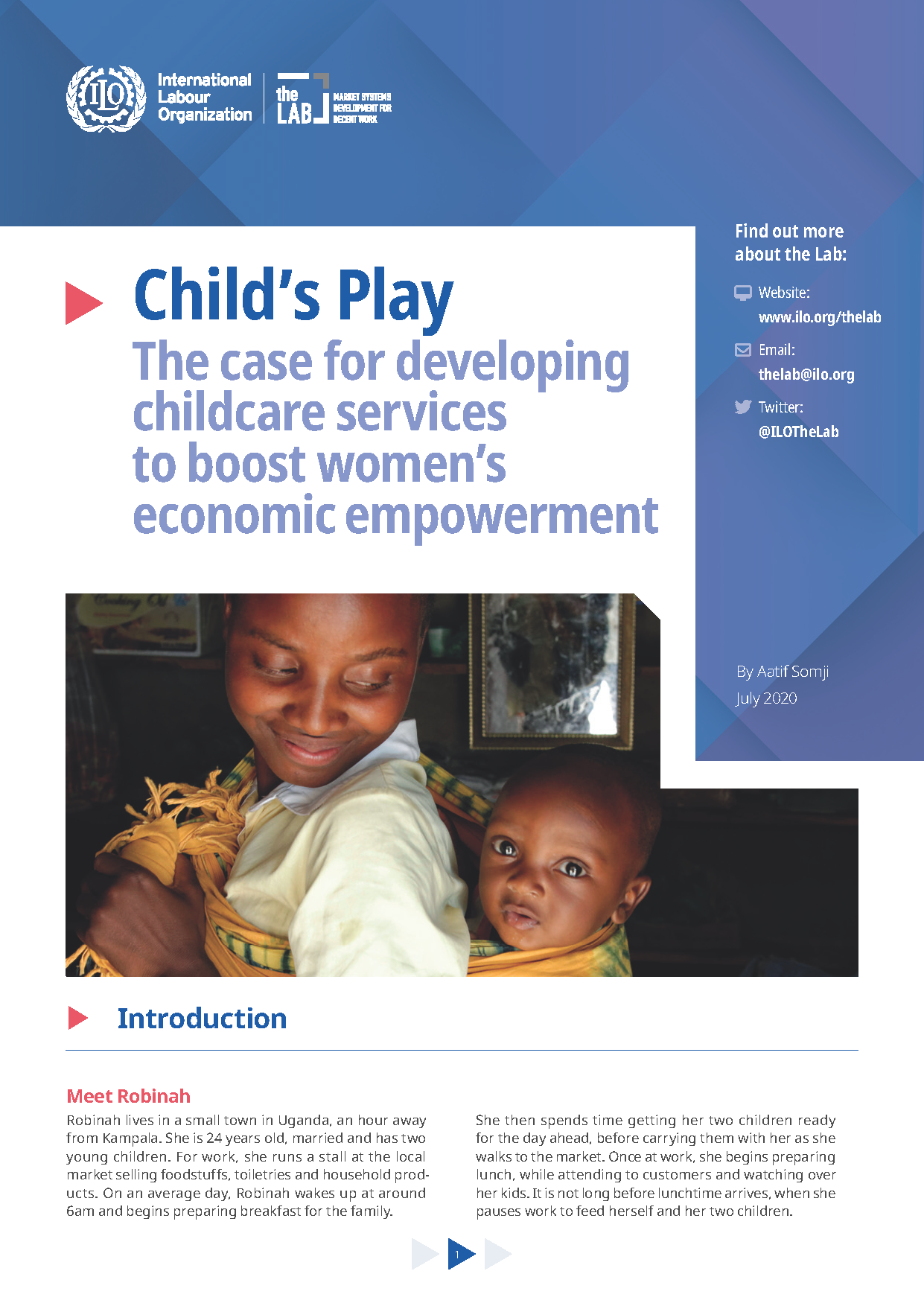
Child’s Play: The Case for Developing Childcare Services to Boost Women’s Economic Empowerment

  2020 | Aatif Somji (International Labour Organization)

Download

The COVID-19 crisis and ensuing confinement has brought to the fore a key constraint to women’s economic empowerment: the unequal, gendered distribution of unpaid care work. Even before the pandemic, women were performing more than three-quarters of all unpaid care work – equating to roughly 12.5 billion hours of unpaid care work done by women every single day.

Whilst there is increasing recognition of unpaid care work and its impact on women’s economic empowerment (WEE), there remains little practical guidance on how to foster its reduction and redistribution among society. One step to achieving this is through the provision of childcare services, which shift care responsibilities away from mothers and other unpaid carers to paid caregivers. In turn, this can contribute to the economic empowerment of women through improved access to labour market opportunities and greater agency over manageable workloads.

It’s for this reason that the ILO Lab decided to research programmes taking a market systems approach to developing childcare services, exploring the different ways that these programmes have addressed the issue as well as the key lessons learned for implementation.

Search by Keyword


Filter by Categories


Topics

  • All
  • Consumer Protection
  • Economic Strengthening and Recovery
  • Financial Inclusion
  • Food Security
  • Fragile and Conflict-affected Environments
  • Health
  • Livelihoods
  • Market Systems
  • Microenterprise
  • Microfinance
  • Monitoring and Evaluation
  • Rural and Agricultural Finance
  • Savings Groups
  • Technology
  • Women and Girls
  • Youth and Children


Thematic Areas

  • All
  • Agriculture & Food Security
  • Resilient Markets
  • Responsible Finance
  • Savings Groups
  • Women’s Economic Empowerment


Language

  • All
  • Arabic
  • English
  • French
  • Portuguese
  • Spanish


Geographical Region

  • All
  • Eastern Europe and Central Asia
  • Global
  • North America
  • South Asia
  • Sub-Saharan Africa
  • Western Europe


Year Published

  • 2021
  • 2020
  • 2019
  • 2018
  • 2017
  • 2016
  • 2015
  • 2014
  • 2013
  • 2012
  • 2011
  • 2010
  • 2009
  • 2008
  • 2007
  • 2006
  • 2005
  • 2004
  • 2003

  • Villkor
  • Ansvarsfullt spelande
  • Integritetspolicy
Copyright © 2026