
The SEEP Network: Leading Collaboration and Learning
  • Casino utan svensk licens
  • Om oss
  • Kontakta oss


  • Contact Us
  • Receive SEEP Updates


  • SEEP Member Space
  • Become a Member

  • About
    • Our Story
    • Our Core Values
    • Our Team
    • Partner with SEEP
    • Board of Directors
    • COVID-19 Response
  • Membership
    • Meet Our Members
    • Benefits
    • How to Apply
    • SEEP & AMEA Partnership
    • SEEP Member Marketplace
    • SEEP Member Space
    • GenerationNOW
  • Thematic Areas
    • Agriculture & Food Security  
      • Agriculture & Food Security Resource Library
    • Resilient Markets  
      • Minimum Economic Recovery Standards
      • Markets in Crises Community of Practice
      • Livelihoods and Inclusive Finance Expansion
      • Disaster Risk Reduction
      • Resilient Markets Resource Library
    • Responsible Finance  
      • Responsible Finance through Local Leadership and Learning
      • Association Services
      • Online Courses and Certification in Digital Finance
      • Responsible Finance Resource Library
    • Savings Groups  
      • Women Saving for Resilience
      • Mastercard Foundation Savings Learning Lab
      • Savings-Led Working Group
      • Savings Groups Evidence and Learning Initiative
      • Red GALAC
      • The Mango Tree
      • SG2020: The Future of Savings Groups
    • Women’s Economic Empowerment  
      • WEE Global Learning Forum
      • WEE Working Group
      • WEE Peer Learning Group
      • AWEF Learning Series
      • WEE Resource Library
  • SEEP Resources
  • Blogs and Webinars
    • Blogs
    • Webinars on Demand
  • Events
  • Conferences
    • 2020 SEEP Annual Conference
    • SG2020: The Future of Savings Groups
    • 2017 Women’s Economic Empowerment Global Learning Forum
  • Contact Us
  • Receive SEEP Updates
  • SEEP Member Space
  • Become a Member


 Back

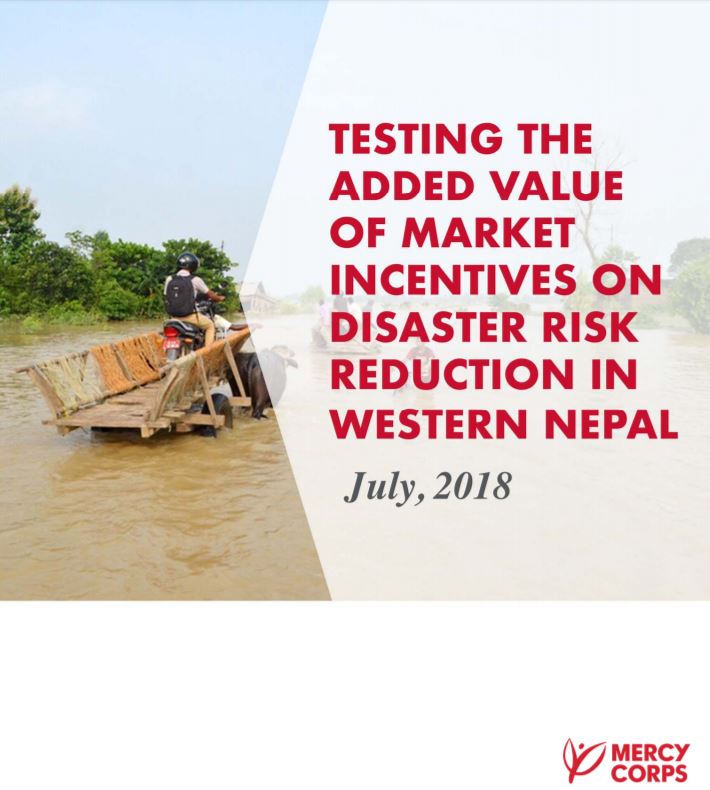
Testing the Added Value of Market Incentives on Disaster Risk Reduction in Western Nepal

  2018 | Mercy Corps

Download

This study aims to understand whether households living in Nepalese communities benefiting from combined market-based and traditional DRR activities (MRED’s nexus model) were better off after the 2017 floods relative to households living in communities without these integrated activities. Specifically, the study explores whether nexus households 1) accessed key resilience resources – financial, social, physical, human and natural prior to the flood, 2) used those capacities to respond to appropriately respond to the flooding and 3) were able to maintain or improve their well-being relative to non-nexus households.

Search by Keyword


Filter by Categories


Topics

  • All
  • Consumer Protection
  • Economic Strengthening and Recovery
  • Financial Inclusion
  • Food Security
  • Fragile and Conflict-affected Environments
  • Health
  • Livelihoods
  • Market Systems
  • Microenterprise
  • Microfinance
  • Monitoring and Evaluation
  • Rural and Agricultural Finance
  • Savings Groups
  • Technology
  • Women and Girls
  • Youth and Children


Thematic Areas

  • All
  • Agriculture & Food Security
  • Resilient Markets
  • Responsible Finance
  • Savings Groups
  • Women’s Economic Empowerment


Language

  • All
  • Arabic
  • English
  • French
  • Portuguese
  • Spanish


Geographical Region

  • All
  • Eastern Europe and Central Asia
  • Global
  • North America
  • South Asia
  • Sub-Saharan Africa
  • Western Europe


Year Published

  • 2021
  • 2020
  • 2019
  • 2018
  • 2017
  • 2016
  • 2015
  • 2014
  • 2013
  • 2012
  • 2011
  • 2010
  • 2009
  • 2008
  • 2007
  • 2006
  • 2005
  • 2004
  • 2003

  • Villkor
  • Ansvarsfullt spelande
  • Integritetspolicy
Copyright © 2026